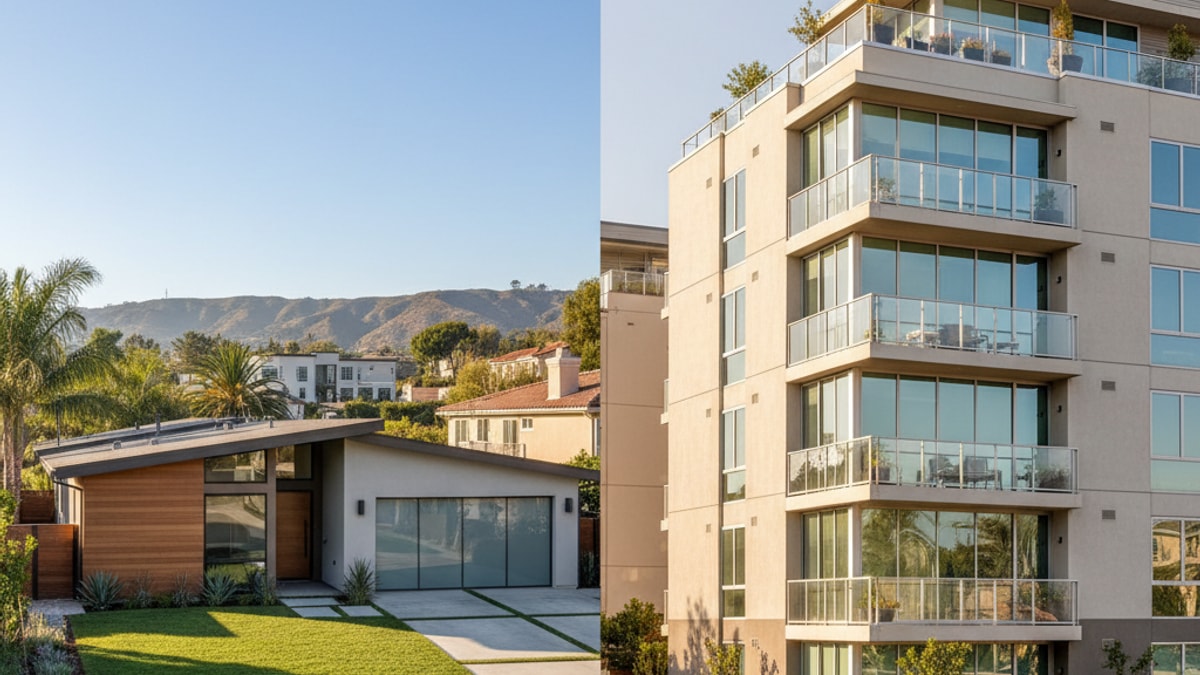
Here’s what most sellers don’t realize about the condo vs house sale California market: condos sit an average of 14 days longer on the market than single-family homes statewide, not because of pricing or location, but because of HOA documentation delays and stricter lender scrutiny on condo approvals. A buyer who can close on a house in 21 days often needs 35–42 days to close on a condo in the same neighborhood. Purely due to the underwriting requirements attached to condo financing.
We’ve worked across hundreds of property transactions in California’s varied markets. The gap between selling a condo smoothly and watching it stall in escrow comes down to three things most listing agents gloss over: HOA documentation completeness, FHA/VA condo approval status, and the buyer pool’s financing limitations.
What’s the biggest difference between selling a condo vs house in California?
The condo vs house sale California distinction hinges on HOA involvement, mandatory disclosures, and financing restrictions. Houses sell to any qualified buyer; condos require buyers whose lenders approve the HOA’s financials, insurance coverage, and owner-occupancy ratios. If the HOA isn’t FHA-approved, you eliminate 15–20% of the buyer pool instantly. And that’s before factoring in special assessments or pending litigation that halt conventional financing entirely.
Here’s what the surface answer misses: most sellers treat the condo vs house sale California decision as a pricing exercise when it’s actually a timeline and buyer-qualification exercise. A house priced at $650,000 competes on condition and location. A condo at the same price competes on those factors plus HOA reserves, monthly dues relative to comparable buildings, and whether the complex meets lender warrantability standards. Buyers who can afford the house payment often can’t qualify for the condo because their DTI (debt-to-income ratio) maxes out once HOA dues are added to the mortgage calculation.
This article covers the transactional mechanics that determine whether your sale moves quickly or hits multiple delays, the disclosure requirements that apply to condos but not houses, and the three underwriting hurdles that disqualify otherwise-qualified buyers from purchasing your condo.
Transaction Timeline and Buyer Financing Differences
The median days-on-market for single-family homes in California sits at 26 days as of early 2026, according to California Association of Realtors data. For condos, that figure stretches to 40 days. Not because condos are less desirable, but because lenders impose additional review layers. Every condo purchase triggers a review of the HOA’s master insurance policy, reserve study, percentage of owner-occupied units, and any pending or settled litigation. Houses require none of this.
Buyer financing splits sharply between property types. FHA loans. Which account for roughly 18% of California home purchases. Require the condo complex to hold FHA approval or undergo a spot approval process that adds 10–15 days to closing. VA loans carry similar restrictions. Conventional loans don’t require formal HOA approval, but they do require the HOA to meet Fannie Mae warrantability standards: at least 50% owner-occupancy, reserve funding above 10% of the annual budget, and no single owner controlling more than 20% of units.
If your condo complex fails any of these tests, your buyer pool contracts to cash buyers and portfolio lenders only. In our experience working with sellers statewide, properties that appear identical on paper. Same square footage, same neighborhood, same list price. Perform entirely differently based solely on HOA approval status. A house listed at $725,000 receives offers from buyers using FHA, VA, conventional, and cash financing. A condo at $725,000 in a non-FHA-approved building receives offers only from conventional and cash buyers, cutting the competitive pressure that drives final sale prices higher.
The other factor most sellers underestimate: HOA documentation turnaround time. California Civil Code Section 4525 requires HOAs to provide a resale disclosure packet within 10 days of request, but many associations take 15–20 days, especially in smaller complexes with volunteer boards. That delay pushes your escrow timeline regardless of how motivated your buyer is.
Mandatory Disclosures and HOA Compliance Requirements
Selling a condo vs house in California triggers different disclosure obligations. Both require the standard Transfer Disclosure Statement (TDS) and Natural Hazard Disclosure (NHD). Condos add the HOA resale package mandated under Civil Code 4525, which includes: governing documents (CC&Rs, bylaws, articles of incorporation), the most recent HOA budget and reserve study, contact information for all HOA vendors and managers, minutes from the past 12 months of board meetings, and a statement of any pending or anticipated special assessments.
The HOA package also discloses any litigation involving the association within the past five years. If the HOA is currently in litigation or settled a case within 12 months, many lenders refuse to finance purchases in that complex. Regardless of the merits of the case. We’ve seen condos priced competitively sit for 90+ days purely because of a resolved construction defect lawsuit that appeared in the disclosure package.
Special assessments create another layer of complexity. If the HOA has levied a special assessment. Whether for roof replacement, seismic retrofitting, or reserve funding. That assessment transfers to the buyer unless explicitly paid off at close of escrow. Buyers’ lenders add the monthly assessment payment to the debt-to-income calculation, which can disqualify buyers who otherwise meet income thresholds. A $400/month special assessment over 36 months reduces buying power by roughly $80,000 for a buyer at maximum DTI.
Houses avoid all of this. The seller discloses property condition, but there’s no third-party entity whose financial health impacts the buyer’s ability to close. No reserve studies. No owner-occupancy ratios. No master insurance policies that lenders scrutinize for coverage gaps.
Buyer Expectations and Negotiation Leverage Shifts
The negotiation dynamics in a condo vs house sale California transaction tilt differently based on HOA factors buyers can’t control. When buying a house, a buyer negotiates over inspection findings, necessary repairs, and credits for deferred maintenance. When buying a condo, those same negotiations happen. But they’re layered on top of non-negotiable HOA factors like monthly dues, upcoming capital expenditures disclosed in the reserve study, and restrictions in the CC&Rs.
Buyers purchasing condos routinely request credits or price reductions based on information in the HOA’s reserve study that has nothing to do with the individual unit. If the reserve study projects a $2M roof replacement in three years and current reserves sit at $400K, buyers assume a special assessment is coming and negotiate accordingly. Sellers have no control over reserve funding or capital planning, but they absorb the pricing impact.
HOA dues also function as a negotiation anchor. Monthly dues above $500 trigger affordability concerns for many buyers, even when those dues cover utilities, insurance, and amenities that single-family homeowners pay separately. Our team has found that condos with dues above $600/month in California’s non-coastal markets take 22% longer to sell than comparable units with dues under $400, purely because of how lenders calculate housing expense ratios.
The flip side: houses create negotiation leverage around repairs the seller controls. A roof with five years of remaining life becomes a $15K credit in negotiations. Outdated HVAC systems, old water heaters, and deferred landscaping all generate repair requests or price concessions. In condo sales, the HOA maintains exterior elements, so those negotiation points disappear. But they’re replaced by HOA-related concerns the seller can’t remedy.
Condo vs House Sale California: Transaction Comparison
| Transaction Factor | Single-Family House | Condominium | Professional Assessment |
|---|---|---|---|
| Median Days on Market (2026) | 26 days statewide | 40 days statewide | Condo timelines reflect lender review of HOA documentation, not property quality |
| Buyer Financing Restrictions | None. All loan types accepted | FHA/VA require complex approval; conventional requires Fannie Mae warrantability | Non-approved HOAs eliminate 15–20% of buyer pool immediately |
| Mandatory Seller Disclosures | TDS, NHD, property-specific reports | TDS, NHD, plus full HOA resale package per Civil Code 4525 | HOA litigation or special assessments disclosed in package often delay or kill deals |
| Buyer Negotiation Leverage | Repair requests, deferred maintenance, inspection findings | Same as house, plus HOA reserve shortfalls, pending assessments, high monthly dues | Sellers absorb pricing impact of HOA issues they don’t control |
| Closing Timeline Flexibility | 21–30 days standard for most buyers | 35–45 days standard due to HOA documentation and lender condo review | Cash buyers close condos faster, but represent smaller percentage of condo buyers than house buyers |
| Impact of Property Condition | Directly affects price and days-on-market | Less impact if HOA maintains exteriors well; condition matters primarily for interiors | Buyers weigh HOA exterior condition equally with unit-specific condition |
Key Takeaways
- Condos in California take an average of 14 days longer to sell than single-family homes due to HOA documentation requirements and stricter lender scrutiny on condo financing.
- FHA and VA loans require condo complexes to meet formal approval standards. Complexes without approval lose 15–20% of the buyer pool.
- Special assessments disclosed in the HOA package reduce buyer purchasing power because lenders add the assessment payment to debt-to-income calculations.
- HOA monthly dues above $500 extend time-on-market by an average of 22% in California’s non-coastal markets by limiting buyer affordability.
- Houses allow sellers to negotiate around property-specific repairs; condos shift negotiations to HOA reserve funding and pending capital projects sellers can’t control.
- California Civil Code 4525 requires HOAs to deliver resale disclosure packets within 10 days, but many take 15–20 days, delaying escrow timelines.
What If: Condo vs House Sale California Scenarios
What If My Condo HOA Isn’t FHA-Approved?
List the property knowing you’ll receive fewer offers and potentially accept a lower price. Non-FHA-approved condos sell primarily to conventional and cash buyers, shrinking your competitive buyer pool by 15–20%. If you’re in a strong seller’s market with low inventory, the impact may be minimal. In a balanced or buyer’s market, expect 10–15 additional days on market and pricing pressure from buyers who recognize their reduced competition.
What If the HOA Has a Pending Special Assessment?
Disclose it immediately in your listing remarks and price accordingly. Buyers’ lenders will add the monthly assessment to their debt calculations, which reduces how much home they can afford. A $300/month assessment over 24 months effectively reduces your buyer’s purchasing power by $60,000–$72,000 depending on interest rates. Pricing $50K below comparable units without assessments often moves the property faster than waiting for a buyer willing to absorb the full financial impact.
What If a Buyer’s Lender Rejects the HOA After We’re in Escrow?
Relist immediately and disclose the lender rejection reason in your notes to future agents. If the rejection stemmed from low reserves, pending litigation, or high investor ownership, you’ll face the same issue with subsequent financed buyers. Shift marketing toward cash buyers or consider owner financing if you’re motivated to close quickly. Some sellers reduce the price by 5–8% to attract cash offers rather than cycle through multiple failed escrows.
What If I’m Selling a House With Significant Deferred Maintenance?
Decide whether to repair or offer credits before listing. In our experience, houses with visible deferred maintenance. Old roofs, dated HVAC, cosmetic neglect. Generate lowball offers that assume worst-case repair costs. Getting three contractor bids and offering a credit for the median bid amount often produces better net proceeds than accepting an offer $40K below ask from a buyer estimating repairs at $60K.
The Unflinching Truth About Condo vs House Sale California
Here’s the honest answer: if your condo complex has an HOA with reserves below 15% of the annual budget, pending or recent litigation, or monthly dues above $550 in a non-luxury market, you will lose buyer competition to comparable single-family homes every time. Even if your unit shows better and is priced lower. The financing restrictions aren’t negotiable and the buyer pool shrinks regardless of how well you’ve maintained your unit.
Most sellers discover this after their first escrow falls apart when the buyer’s lender reviews the HOA docs and denies the loan. The second time, they price more aggressively. The third time, they list with a cash buyer specialist. We mean this sincerely: if you’re selling a condo, request a copy of your HOA’s reserve study and master insurance policy before you list. Not after you’ve accepted an offer. Those two documents determine your realistic buyer pool more than any other factor.
Single-family homes avoid these financing tripwires entirely. You’ll negotiate over inspection findings and property condition, but you won’t lose qualified buyers because of third-party financial decisions you can’t influence. That difference compounds across the entire transaction timeline and explains why houses consistently close faster than condos at similar price points.
The decision isn’t about which property type is better. It’s about understanding which transaction path you’re entering and pricing for the buyer pool that can actually close. Condos with strong HOA financials, FHA approval, and reasonable monthly dues sell as quickly as comparable houses. Condos without those factors require different pricing strategies, longer timelines, and acceptance that some buyers will walk based on information you can’t control.
If the HOA financials concern you before listing, address them in your pricing model upfront. Not after the property’s been sitting for 60 days with three failed escrows behind you. Sellers who acknowledge the transaction differences in the condo vs house sale California market from day one consistently net better outcomes than those who assume the processes are identical and adjust only after multiple deal failures.
Our team at Home Helpers has guided sellers through both transaction types across California’s diverse markets. The gap between a smooth sale and a stalled listing almost always traces back to whether the seller understood their specific transaction path before going live. And priced accordingly from the start.
Frequently Asked Questions
How much longer does it take to sell a condo vs house in California?
Condos take an average of 14 days longer to sell than single-family homes in California — 40 days vs 26 days median time-on-market statewide. The difference stems from lender review of HOA documentation, buyer financing restrictions tied to condo approval status, and HOA disclosure packet turnaround times that often exceed the 10-day mandate under Civil Code 4525.
Can I sell my California condo if the HOA isn’t FHA-approved?
Yes, but you’ll sell only to conventional and cash buyers, eliminating 15–20% of the typical buyer pool. FHA and VA loans require condo complexes to meet formal approval standards. Non-approved complexes force buyers to use conventional financing or pay cash, reducing competitive pressure and often extending days-on-market by 10–15 days in balanced or buyer’s markets.
What does a condo sale cost compared to a house sale in California?
Transaction costs are nearly identical — both pay standard real estate commissions, title insurance, escrow fees, and transfer taxes. The difference appears in net proceeds: condos with high HOA dues or pending special assessments often sell for 5–8% below comparable houses because buyers factor ongoing HOA obligations into their purchase price calculations, even when those obligations cover services single-family buyers pay separately.
What happens if my condo HOA has pending litigation during the sale?
Most lenders refuse to finance purchases in complexes with active litigation, regardless of case merits. Your buyer pool shrinks to cash buyers and portfolio lenders willing to assume the risk. If litigation was settled within the past 12 months, many conventional lenders still decline financing. Disclose the litigation status in your listing to avoid multiple failed escrows with financed buyers.
Which sells faster in California — a condo or a house with similar pricing?
Single-family homes sell faster in 78% of comparable price-point matchups, according to California Association of Realtors 2026 data. The exceptions are luxury condos in high-demand urban cores where HOAs are well-funded, FHA-approved, and monthly dues include premium amenities. In suburban and mid-tier markets, houses consistently outpace condos by 12–18 days median time-on-market.
Do special assessments affect how quickly I can sell my California condo?
Yes — significantly. Lenders add special assessment payments to buyers’ debt-to-income ratios, which reduces purchasing power. A $400/month assessment over 36 months cuts buyer qualification by roughly $80,000. Buyers who can afford your asking price pre-assessment often can’t qualify post-assessment. Expect 15–25 additional days on market and pricing pressure of 6–10% below non-assessed comparable units.
What disclosures are required for condo sales that houses don’t require?
Condos require the full HOA resale package mandated under California Civil Code 4525: governing documents, current budget, reserve study, 12 months of board meeting minutes, vendor contact information, and disclosure of any litigation or special assessments within the past five years. Houses require only Transfer Disclosure Statement and Natural Hazard Disclosure — no third-party financial documentation.
Can high HOA dues prevent my California condo from selling?
High dues don’t prevent sales, but they extend time-on-market and reduce final sale prices. Monthly dues above $500 trigger affordability concerns because lenders include them in housing expense ratios. Condos with $600+ monthly dues take 22% longer to sell than comparable units under $400/month in non-coastal California markets, even when higher dues cover utilities and amenities that offset the cost difference.
Why do condo buyers in California request price reductions for HOA reserve shortfalls?
Reserve studies project future capital expenditures and current funding levels. When reserves fall below 15% of annual budgets or major projects loom without adequate funding, buyers anticipate special assessments within 18–36 months. They negotiate price reductions to offset expected future costs, even though sellers have no control over HOA financial planning or reserve contribution rates.
Should I sell my California condo or house first if I own both?
Sell the condo first if both are move-in ready and priced competitively. Condos take longer to close due to HOA documentation and lender review timelines — starting that process first prevents dual carrying costs. If the condo requires HOA approval verification or has known financing obstacles, sell the house first to avoid being stuck with both properties if the condo sits longer than projected.
