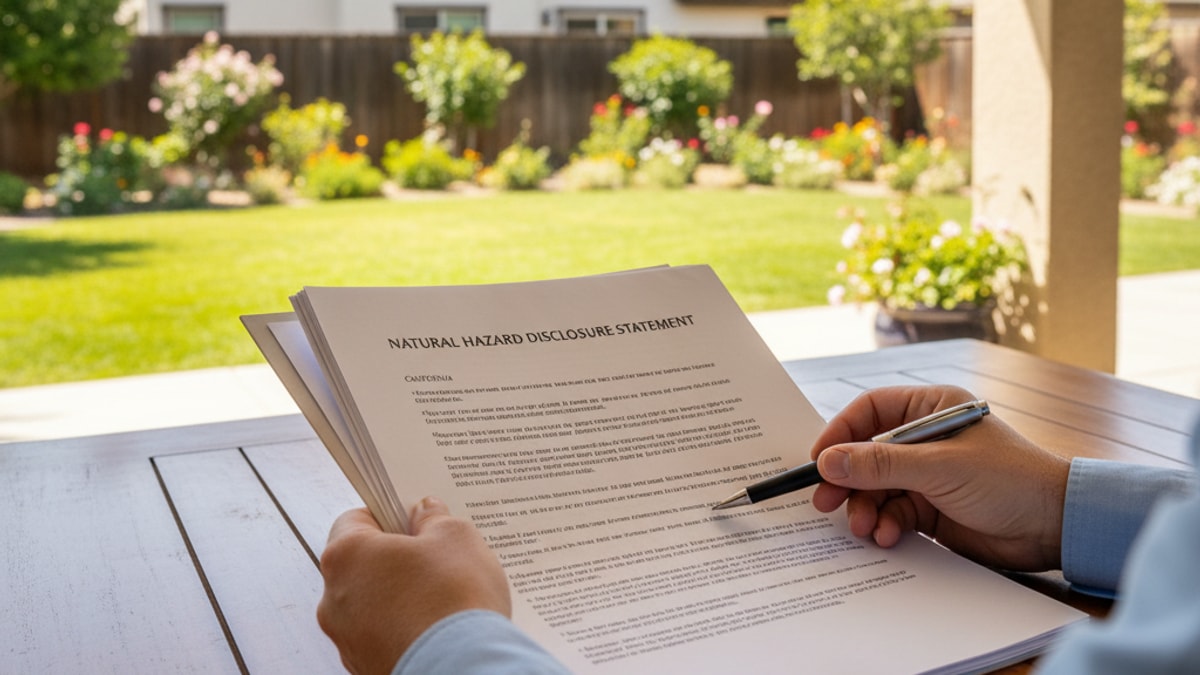
Natural Hazard Disclosure California — What Sellers Must Know
Here’s what catches sellers off guard: California doesn’t just require you to disclose property hazards you know about. It requires you to conduct a formal search of government databases to identify hazards you don’t know about, then disclose those findings in writing before the sale closes. Miss a single required hazard category on your Natural Hazard Disclosure and the buyer can rescind the transaction up to three years after closing under California Civil Code § 1102.6. The Natural Hazard Disclosure isn’t a courtesy. It’s a legally binding document that can void your sale retroactively if incomplete.
We’ve guided hundreds of California homeowners through real estate transactions over the past decade. The confusion around Natural Hazard Disclosure compliance is consistent. Sellers assume their real estate agent handles it, agents assume escrow handles it, and escrow assumes a third-party vendor handles it. When coordination breaks down, the seller is liable regardless of who dropped the ball.
What Is a Natural Hazard Disclosure in California?
Contact Home Helpers Group to discuss your property and request a no-obligation cash offer.
Most sellers don’t know this. But Natural Hazard Disclosure compliance in California isn’t a one-page checkbox. It’s a specific statutory requirement with exact language, exact map sources, and exact delivery timelines that vary by county. The distinction matters because an incomplete NHD can be used to challenge a sale years after closing, and insurance companies use NHD findings to set premiums or deny coverage. This article covers the exact hazards that must be disclosed, which government sources are legally acceptable, what happens when disclosures are incomplete, and the difference between a compliant NHD report and a form that looks right but fails audit.
What Hazards Must Be Disclosed Under California Law
California law requires sellers to disclose six specific hazard zone designations before closing. The first is Special Flood Hazard Area (SFHA) status as mapped by FEMA. If the property falls within Zone A or Zone V on FEMA’s Flood Insurance Rate Map (FIRM), the buyer is legally required to purchase flood insurance to secure a federally backed mortgage. The second is Very High Fire Hazard Severity Zone (VHFHSZ), a CalFire designation that identifies areas where fire risk warrants additional building code requirements and vegetation clearance mandates. The third is State Fire Responsibility Area (SRA), which determines whether the state or local fire department has primary wildfire suppression authority. Properties within SRA boundaries may be subject to annual fire prevention fees.
The fourth required disclosure is Earthquake Fault Zone status under the Alquist-Priolo Earthquake Fault Zoning Act. Properties within these zones require a geologic investigation before new construction or significant remodeling. The fifth is Seismic Hazard Zone designation under the Seismically Induced Landslide Zone or Liquefaction Zone maps published by the California Geological Survey (CGS). These zones indicate elevated risk of ground failure during seismic events. The sixth is Dam Inundation Area, which identifies properties that would be affected if a nearby dam failed. These maps are maintained by the California Office of Emergency Services and specify evacuation routes.
Each hazard designation comes from a different government agency with different update cycles. FEMA flood maps are revised irregularly. Some counties operate on 1980s-era maps while others were remapped in 2023. CalFire’s VHFHSZ maps were last comprehensively updated in 2008 but are revised at the local level as development patterns change. Earthquake Fault Zones are updated as new fault traces are discovered. The most recent additions occurred in 2024. Seismic Hazard Zones have been published for only 16 California counties as of 2026. Properties in unmapped counties are not exempt from the requirement, they simply fall outside designated zones by default. Dam Inundation Area maps are updated following dam safety inspections, which occur on five-year cycles for high-hazard dams.
How to Obtain a Compliant Natural Hazard Disclosure Report
Professionally prepared NHD reports are completed by third-party vendors licensed under California Business and Professions Code § 11010. These companies access the same government map sources but provide a single consolidated report with map excerpts, legal descriptions, and liability coverage. The standard turnaround time is 24–48 hours and the cost ranges from $85 to $175 depending on county and property complexity. The vendor’s liability coverage is critical. If the report contains an error that leads to a claim, the vendor’s errors and omissions insurance covers the loss up to policy limits. Sellers who prepare their own NHD forms bear full liability for any omissions or inaccuracies.
Natural Hazard Disclosure California: Comparison of Report Sources
| Hazard Category | Government Map Source | Update Frequency | Mortgage/Insurance Impact | Professional Assessment |
|---|---|---|---|---|
| Special Flood Hazard Area (SFHA) | FEMA Flood Insurance Rate Map (FIRM) | Irregular. Varies by county, 5–20 year cycles | Flood insurance mandatory in Zones A and V for federally backed loans | Most consequential for buyers. Directly affects loan approval and annual insurance cost of $500–$2,000 |
| Very High Fire Hazard Severity Zone (VHFHSZ) | CalFire VHFHSZ maps | Last comprehensive update 2008, local revisions ongoing | Homeowner’s insurance rates increase 15–40% in VHFHSZ areas; some insurers deny coverage | Second-highest buyer concern in 2026. Insurability issues are delaying closings statewide |
| State Fire Responsibility Area (SRA) | CalFire SRA maps | Revised annually | Annual SRA fire prevention fee of $152 per habitable structure | Fee is minor but SRA status often overlaps with VHFHSZ, compounding insurance difficulty |
| Earthquake Fault Zone | Alquist-Priolo Earthquake Fault Zoning Act maps (CGS) | Updated as new faults are discovered. Most recent additions 2024 | No direct mortgage impact; geologic reports required for new construction | Disclosure requirement is strict but actual risk varies. Proximity to fault trace matters more than zone boundary |
| Seismic Hazard Zone (Liquefaction/Landslide) | California Geological Survey Seismic Hazard Zone maps | Published for 16 counties as of 2026 | No direct mortgage impact; affects foundation design for new builds | Only applies in mapped counties. Most of California is unmapped and not subject to this disclosure |
| Dam Inundation Area | County Office of Emergency Services Dam Inundation maps | Updated following dam safety inspections (5-year cycles for high-hazard dams) | No direct mortgage impact; may affect homeowner’s insurance availability | Least common hazard but highest consequence if dam failure occurs. Buyers should verify evacuation routes |
Key Takeaways
- California sellers must disclose six specific hazard zones. Special Flood Hazard Area, Very High Fire Hazard Severity Zone, State Fire Responsibility Area, Earthquake Fault Zone, Seismic Hazard Zone, and Dam Inundation Area. Before transfer of title using government map sources dated within the transaction period.
- A Natural Hazard Disclosure delivered after closing gives the buyer a three-year window to rescind the sale under California Civil Code § 1102.6. The seller’s liability does not end when escrow closes.
- Professionally prepared NHD reports cost $85–$175 and include errors and omissions insurance coverage. Sellers who prepare their own forms using government maps bear full liability for any inaccuracies or omissions.
- Properties in Special Flood Hazard Areas (FEMA Zones A and V) require flood insurance for federally backed mortgages. Annual premiums range from $500 to $2,000 depending on elevation and flood zone designation.
- Very High Fire Hazard Severity Zone properties face homeowner’s insurance rate increases of 15–40% and coverage denials from major carriers. This is the disclosure finding that most frequently derails California transactions in 2026.
What If: Natural Hazard Disclosure Scenarios
What If the Property Is in Multiple Hazard Zones?
Disclose all applicable hazards on the NHD form. There is no limit to the number of zones that must be reported. Properties in California’s coastal and foothill regions commonly fall within three or more hazard zones simultaneously (VHFHSZ + SRA + Seismic Hazard Zone is a typical combination). Each hazard must be listed separately with its corresponding map source and date. Buyers cannot waive the disclosure requirement even if they verbally acknowledge awareness of the hazards. The written NHD must list every applicable zone.
What If the Hazard Maps Were Updated After the Sale Started?
Use the map version in effect on the date the NHD report was ordered. Sellers are not required to reissue the disclosure if maps are updated mid-transaction. However, if a map update occurs before the NHD is delivered to the buyer, the updated map must be used. California courts have consistently ruled that the disclosure obligation is measured at the time of delivery, not the time of contract execution. If you become aware of a map change after delivering the NHD but before closing, consult your real estate attorney. Reissuance may be required depending on the materiality of the change.
What If the Buyer Waives Their Right to Review the NHD?
California Civil Code § 1103 does not permit buyers to waive the Natural Hazard Disclosure requirement. The seller must deliver a compliant NHD regardless of whether the buyer requests it. The buyer can waive their three-day review period after receiving the NHD, but the disclosure itself cannot be waived. Transactions that close without a delivered NHD give the buyer a three-year rescission window even if the buyer verbally stated they didn’t need the report. This is a strict liability statute. Intent and verbal agreements are irrelevant.
The Blunt Truth About Natural Hazard Disclosure Compliance
Here’s the honest answer: most Natural Hazard Disclosure errors aren’t intentional. They’re coordination failures between the seller, agent, escrow officer, and NHD vendor. The seller assumes the agent ordered the report. The agent assumes escrow ordered it. Escrow assumes the seller will handle it because the purchase agreement says ‘seller to provide NHD.’ The report gets ordered two days before closing, delivered without a buyer signature, and filed in escrow with no confirmation that the buyer received it. Three months after closing, the buyer discovers they’re in a Very High Fire Hazard Severity Zone when their insurance is non-renewed. The buyer’s attorney reviews the escrow file, finds no signed NHD acknowledgment, and files to rescind.
The liability chain in Natural Hazard Disclosure disputes is unforgiving. The statute places the disclosure obligation on the seller. Not the agent, not the escrow company, not the NHD vendor. If the report is never delivered, incomplete, or based on outdated maps, the seller is liable even if a vendor was paid to prepare it. We’ve worked with sellers who paid for professional NHD reports that were never sent to the buyer because the escrow officer thought the agent was handling delivery. The transaction closed. Six months later, the buyer sued. The seller’s defense. ‘I paid for the report’. Is not a statutory defense to non-delivery.
The takeaway: require written confirmation that the buyer received and signed the NHD acknowledgment form before you authorize escrow to release funds. One signed form prevents three years of rescission exposure.
If the Natural Hazard Disclosure process feels opaque, that’s because it is. Until something goes wrong. At that point, you’ll discover California courts interpret the NHD statute strictly and in favor of buyers. A $150 professionally prepared report with proof of delivery is the difference between a closed transaction and an open liability window. We’ve reviewed enough post-closing disputes to know the pattern: sellers who confirm delivery in writing before closing don’t get sued. Sellers who assume it was handled always face questions later. The signed acknowledgment form is your evidence that the statutory obligation was met. Without it, you’re defending a claim with nothing but testimony about what you thought happened. Get the signature. Keep a copy. That one document eliminates 95% of Natural Hazard Disclosure litigation risk.
Frequently Asked Questions
Who is required to provide a Natural Hazard Disclosure in California?
The seller is required to provide a Natural Hazard Disclosure for all real property sales of one to four residential units in California under Civil Code § 1103. The obligation applies to single-family homes, condominiums, townhomes, and multi-unit properties up to four units. Commercial properties and residential buildings with five or more units are exempt from the NHD requirement. The seller cannot delegate the legal obligation to the real estate agent or escrow officer — the statute places liability directly on the seller even if a third party is hired to prepare the report.
How much does a professional Natural Hazard Disclosure report cost in California?
Professional Natural Hazard Disclosure reports in California cost between $85 and $175 depending on the county and property complexity. The fee covers access to all six required government map sources, preparation of a consolidated report with map excerpts and legal descriptions, and errors and omissions insurance coverage in case the report contains inaccuracies. Turnaround time is typically 24 to 48 hours from order placement. Sellers can prepare their own NHD forms at no cost by manually cross-referencing government maps, but they bear full liability for any errors or omissions.
Can a buyer cancel a California home purchase after receiving the Natural Hazard Disclosure?
Yes — California Civil Code § 1103.4 gives buyers three days after receiving the Natural Hazard Disclosure to review the findings and cancel the transaction without penalty. If the buyer cancels within this three-day window, the seller must return the buyer’s deposit in full. After the three-day period expires, the buyer can still cancel based on NHD findings if the purchase agreement includes a contingency for unsatisfactory property disclosures, but the specific terms depend on the contract language. If the NHD is delivered after closing, the buyer has up to three years to rescind the sale.
What happens if a seller does not provide a Natural Hazard Disclosure before closing?
If the seller does not provide a Natural Hazard Disclosure before closing, the buyer can rescind the transaction and recover damages for up to three years after the sale under California Civil Code § 1102.6. The buyer does not need to prove financial harm to rescind — the failure to deliver a compliant NHD is sufficient grounds. The seller may also be liable for the buyer’s attorney fees and court costs. California courts interpret the NHD statute strictly — intent, verbal disclosures, and post-closing delivery do not cure a failure to deliver the NHD during escrow.
Do Natural Hazard Disclosure requirements apply to properties sold ‘as-is’ in California?
Yes — Natural Hazard Disclosure requirements apply to all residential property sales in California regardless of whether the property is sold ‘as-is’ under Civil Code § 1103. The ‘as-is’ clause waives the seller’s obligation to make repairs but does not waive the disclosure obligation. Sellers must deliver a compliant NHD even if the purchase agreement states the buyer is accepting the property in its current condition. Buyers cannot waive their right to receive the NHD, and transactions that close without one give the buyer a three-year rescission window.
How does being in a Very High Fire Hazard Severity Zone affect property insurance in California?
Properties located in a Very High Fire Hazard Severity Zone (VHFHSZ) in California typically face homeowner’s insurance premium increases of 15 to 40 percent compared to properties outside these zones. Some major insurance carriers have stopped offering new policies or non-renewed existing policies in VHFHSZ areas as of 2026 due to wildfire risk. Buyers purchasing VHFHSZ properties may need to secure coverage through the California FAIR Plan, a state-mandated insurer of last resort that provides basic fire coverage at higher premiums. VHFHSZ status is disclosed on the Natural Hazard Disclosure and is the hazard finding that most frequently affects transaction feasibility.
Are there any California counties exempt from Natural Hazard Disclosure requirements?
No California counties are exempt from Natural Hazard Disclosure requirements, but the specific hazards that must be disclosed vary by location. All six hazard categories must be researched for every property, but many properties fall outside designated hazard zones. For example, Seismic Hazard Zone maps have been published for only 16 California counties as of 2026 — properties in unmapped counties are not subject to Seismic Hazard Zone disclosure because no official zones exist. Dam Inundation Area maps are maintained at the county level and are not available for all jurisdictions. The disclosure obligation requires sellers to identify which hazards apply based on current government map sources.
What is the difference between a Special Flood Hazard Area and a flood zone on a Natural Hazard Disclosure?
A Special Flood Hazard Area (SFHA) refers specifically to FEMA-designated flood zones where the annual probability of flooding is 1 percent or greater — these zones are labelled A, AE, AH, AO, AR, A99, and V on FEMA Flood Insurance Rate Maps. Properties in SFHA zones require flood insurance as a condition of obtaining a federally backed mortgage. The term ‘flood zone’ is broader and includes all FEMA flood zone designations including low-risk zones like B, C, and X, which do not require mandatory flood insurance. The Natural Hazard Disclosure in California requires disclosure only of SFHA status, not all flood zone designations.
How long is a Natural Hazard Disclosure report valid in California?
A Natural Hazard Disclosure report is valid for the specific transaction for which it was prepared — there is no statutory expiration period. However, if government hazard maps are updated between the date the NHD report was ordered and the date the property closes, the seller may be required to reissue the disclosure using the updated maps. California courts have ruled that the disclosure obligation is measured at the time of delivery to the buyer, not the time of report preparation. Sellers who reuse an NHD report from a prior transaction or a failed sale bear liability if the underlying maps have changed.
Can a real estate agent prepare the Natural Hazard Disclosure on behalf of the seller?
A real estate agent can coordinate the Natural Hazard Disclosure process by ordering a report from a licensed vendor or assisting the seller in cross-referencing government maps, but the legal obligation to deliver a compliant NHD remains with the seller under California Civil Code § 1103. The agent does not assume liability for NHD accuracy or delivery simply by facilitating the process. If the agent prepares the NHD form manually and makes an error, the seller is liable for the omission — not the agent, unless the agent’s negligence rises to the level of a breach of fiduciary duty. Most agents recommend sellers use professional NHD vendors to avoid this liability gap.
