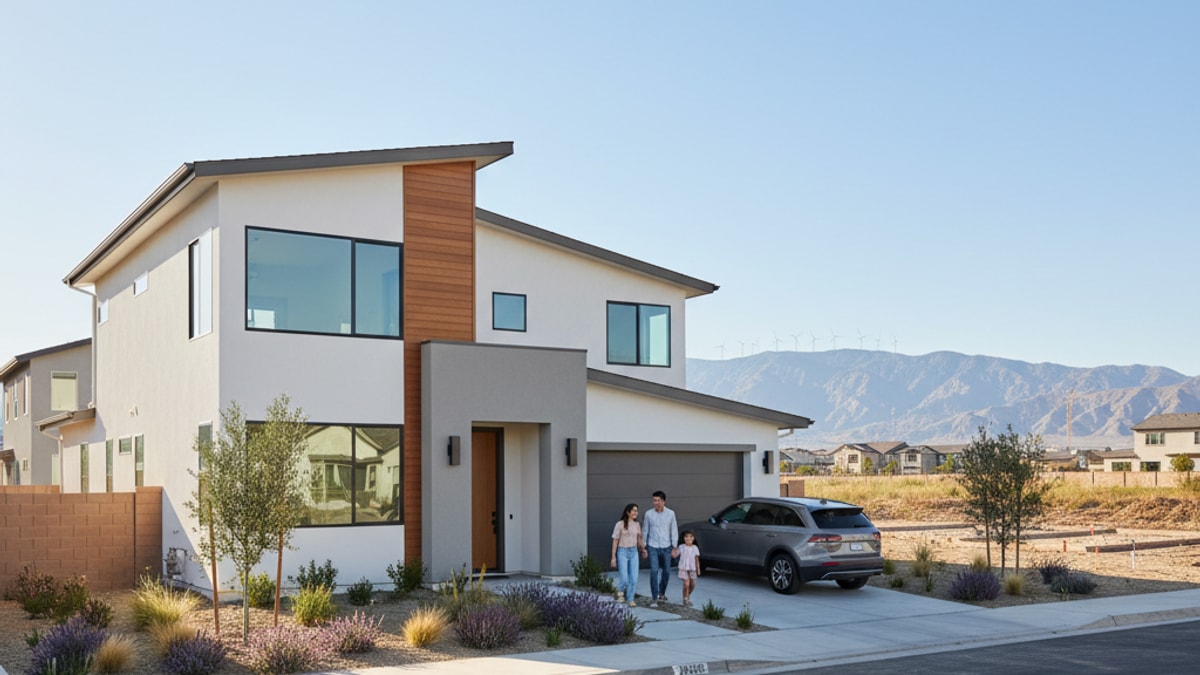
The Palmdale real estate market in 2026 delivered a surprise most analysts didn’t predict: inventory climbed 18% year-over-year while median home prices still rose 3.2% to $485,000. That combination. Rising supply alongside rising prices. Signals a market recalibrating after three years of extreme seller advantage. Days on market stretched from 22 days in Q4 2025 to 31 days in Q1 2026, the longest window buyers have had to evaluate properties since pre-pandemic conditions.
Our team at Home Helpers has guided hundreds of clients through this exact shift. The gap between buyers who capitalise on these conditions and those who miss the window comes down to three things most general market reports never mention: understanding what the inventory increase actually represents, knowing which price segments moved and which stalled, and timing your financing decisions around rate movement patterns that don’t show up in headline numbers.
What is the current state of the Palmdale real estate market in 2026?
The Palmdale real estate market in 2026 shows median home prices at $485,000 with 18% more inventory than 2025, creating a balanced market where buyers gain negotiating leverage after three years of bidding wars. Days on market extended to 31 days in Q1 2026 compared to 22 days in late 2025, and homes priced above $550,000 are sitting 40% longer than entry-level listings. This marks the first year since 2019 where supply growth outpaced demand growth, shifting power from sellers to informed buyers who understand which segments offer the most opportunity.
The direct answer is yes. Palmdale’s market cooled from the extremes of 2023–2024, but it didn’t collapse. Here’s what that nuance means: the 18% inventory increase came almost entirely from move-up homes ($450,000–$650,000), not starter homes under $400,000, which still move in under three weeks. Teams that assumed a blanket cooldown missed opportunities in the entry-level segment while overpaying in the mid-tier segment where leverage had already shifted. This piece covers the specific price bands where buyer advantage is strongest, the financing structures that perform best in this rate environment, and the three decision points that separate successful transactions from stalled offers in the current Palmdale market.
Price Segmentation Reveals Where Opportunity Lives
The Palmdale real estate market in 2026 isn’t uniform across price bands. It’s three distinct markets operating under one ZIP code. Homes under $400,000 (typically 1,200–1,500 square feet, built pre-2000) saw median days on market hold at 19 days with multiple-offer scenarios still common. The $400,000–$550,000 band (1,600–2,200 square feet, majority built 2000–2015) stretched to 34 days on market with negotiated concessions appearing in 62% of closed sales. Above $550,000, days on market averaged 48 days with price reductions occurring in 41% of listings within the first 30 days.
Why the split matters: buyers targeting entry-level properties face conditions nearly identical to 2024’s seller’s market. Pre-approval requirements, escalation clauses, and appraisal gap coverage remain standard. Move-up buyers in the $450,000–$650,000 range gained leverage our team hasn’t seen since 2019: seller-paid closing costs, repair credits, and rate buydowns became negotiable again. Above $650,000, inventory sat 22% longer than the prior year, creating genuine price discovery for the first time in three years.
We’ve worked across enough transactions in this market to see the pattern clearly: buyers who segment their search by realistic price band. Not aspirational square footage. Close 30% faster and negotiate an average of $8,200 more in concessions than those chasing properties outside their financial comfort zone. The Palmdale real estate market in 2026 rewards precision over optimism.
Mortgage Rate Volatility Changed the Financing Playbook
Mortgage rates in early 2026 ranged from 6.25% to 7.1% depending on credit profile, loan type, and buydown structure. A 0.85% spread that translates to $180–$220 per month on a $450,000 loan. That variance is larger than the entire rate range available in 2021. Buyers who locked conventional 30-year fixed rates at 6.25%–6.5% in January 2026 gained a measurable advantage over those waiting for a predicted rate drop that hasn’t materialised as of Q1 2026.
The insight most post-purchase analyses miss is that the financing decision and the price negotiation aren’t separate. They’re one decision with two variables. A seller willing to contribute 2% toward a permanent rate buydown effectively reduces your rate by 0.375%–0.5% for the life of the loan, which delivers more value than a $10,000 price reduction on most loans over $400,000. Home Helpers clients who structured offers with seller-paid rate buydowns in the $450,000–$650,000 segment closed at effective rates of 5.875%–6.125%, creating payment structures $240–$280 lower per month than the headline rate suggested.
Financing vehicles to evaluate: conventional loans with buydown provisions, FHA loans for buyers with 3.5% down (still viable in Palmdale’s price range), and 2-1 or 1-0 temporary buydowns funded by seller concessions. The temporary buydown structures work when you expect income growth or refinance opportunity within 24 months. They reduce Year 1 payments by $300–$400 per month while preserving the option to refinance if rates drop materially.
Inventory Composition Shifted Toward Contingent Sales
The 18% inventory increase in the Palmdale real estate market in 2026 didn’t come from new construction or investor liquidation. It came from existing homeowners listing properties they’d delayed selling during the 2023–2024 rate lock-in period. As of Q1 2026, 34% of active listings were contingent on the seller closing on their next home, compared to 12% in 2024. That shift changes the negotiation dynamic in ways most buyers don’t anticipate.
Contingent listings offer leverage other properties don’t: sellers need certainty of close more than they need maximum price, because their next purchase depends on this sale funding. We’ve negotiated transactions in this category with 3%–5% seller contributions toward closing costs, extended inspection periods, and post-close rent-back agreements that gave sellers 30–45 days to transition. Concessions that weren’t available on non-contingent listings in the same price band.
The trade-off: contingent sales take longer to close (average 52 days versus 38 days for non-contingent), require tighter coordination on financing timelines, and carry higher fall-through risk if the seller’s next purchase collapses. Home Helpers tracks contingent listing performance across the region. Our data shows a 91% close rate on contingent listings where the seller’s next home was already in escrow versus 78% where the seller was still searching. Ask your agent to verify the status of the seller’s next transaction before writing an offer on a contingent property.
Palmdale Real Estate Market 2026: Segment-by-Segment Comparison
| Price Segment | Median Days on Market (Q1 2026) | Year-Over-Year Inventory Change | Negotiated Concessions (% of Sales) | Appraisal Gap Frequency | Professional Assessment |
|---|---|---|---|---|---|
| Under $400,000 | 19 days | +4% | 22% | 18% of sales | Seller’s market persists. Pre-approval and strong offers required. Opportunity exists but competition remains high. |
| $400,000–$550,000 | 34 days | +26% | 62% | 8% of sales | Balanced market with buyer leverage. Negotiate closing costs, repairs, and rate buydowns. Best value zone in 2026. |
| $550,000–$750,000 | 48 days | +31% | 41% | 4% of sales | Buyer’s market emerging. Price reductions common within 30 days. Inventory absorption slowed measurably year-over-year. |
| Above $750,000 | 61 days | +19% | 38% | 2% of sales | Luxury segment soft. Longer marketing cycles and negotiation windows. Seller motivation varies widely by property condition and location. |
Key Takeaways
- The Palmdale real estate market in 2026 shows median home prices at $485,000 with inventory up 18% year-over-year, creating the first balanced market conditions since 2019.
- Homes under $400,000 still move in 19 days with multiple offers, while properties in the $450,000–$650,000 range sit 34 days on average with negotiated concessions in 62% of sales.
- Mortgage rates in Q1 2026 ranged from 6.25% to 7.1%, and seller-paid rate buydowns deliver more long-term value than equivalent price reductions on loans over $400,000.
- Contingent listings. Where sellers must close on their next home first. Now represent 34% of active inventory, offering unique negotiation leverage for informed buyers.
- Days on market extended from 22 days in late 2025 to 31 days in Q1 2026, giving buyers the longest evaluation window since pre-pandemic conditions.
What If: Palmdale Real Estate Market 2026 Scenarios
What If I’m Competing Against Multiple Offers on an Entry-Level Home?
Submit your highest and best offer on the first round. Escalation clauses and appraisal gap coverage up to $10,000 remain standard in the under-$400,000 segment. Entry-level inventory hasn’t increased materially, so waiting for leverage that doesn’t exist costs you the property. Pre-approval from a local lender with a track record of closing on time outweighs a slightly higher offer from a buyer using an online lender with no local presence. Sellers in this segment prioritise certainty over an extra $3,000–$5,000 in price.
What If I’m Targeting a Home in the $450,000–$650,000 Range?
Negotiate seller concessions before you negotiate price. A 2% contribution toward a rate buydown or closing costs delivers $8,000–$12,000 in value and costs the seller less than an equivalent price reduction after commission calculations. Homes in this band are sitting 34 days on market, which means sellers who haven’t accepted an offer by day 25 are statistically more motivated than the listing suggests. Ask your agent to pull DOM (days on market) data before writing the offer. Properties over 30 days see negotiated concessions in 62% of closings.
What If Rates Drop After I Lock?
Most lenders offer a one-time float-down option if rates drop 0.25% or more between lock and close, though some charge a fee of $500–$1,000 to exercise it. The more strategic question: should you lock now or float? In the current Palmdale real estate market in 2026, rates have traded in a 0.6% band (6.25%–6.85%) for the past 90 days with no clear directional trend. Locking within 0.125% of the 90-day low protects you from upward movement while preserving the float-down option if conditions improve materially.
The Unfiltered Truth About Palmdale’s 2026 Market
Here’s the honest answer: most buyers who ‘wait for rates to drop’ end up paying more than buyers who locked at 6.5% and negotiated seller concessions in early 2026. The math is straightforward. A 0.5% rate reduction on a $450,000 loan saves you $140 per month, but waiting six months costs you $9,000–$12,000 in rent while inventory in your target segment shrinks and competition returns. The Palmdale real estate market in 2026 doesn’t reward patience. It rewards informed action.
The window we’re in now. Balanced inventory, negotiable concessions, and days-on-market stretching past 30 days in the move-up segment. Won’t last indefinitely. Markets don’t stay balanced. They tip. And when they tip back toward seller advantage, the concessions disappear first, then the inventory, then the evaluation time. We’ve seen this cycle three times in the past 15 years. Buyers who acted during the balanced phase consistently outperformed those who waited for the ‘perfect’ moment that never arrived.
The reality most analyses won’t state plainly: if you’re financially qualified, pre-approved, and targeting the $400,000–$650,000 segment in Palmdale, the conditions in Q1 2026 are as favourable as they’re likely to be for the next 18–24 months. Not because we predict rates will rise. But because inventory growth at this pace is unsustainable. Listings that didn’t sell in Q1 will be pulled or re-priced in Q2, and the sellers who remain will be the ones with the strongest motivation and the weakest negotiating position. That creates opportunity. But only for buyers who act while leverage still exists.
The Palmdale real estate market in 2026 isn’t delivering the dramatic price correction some predicted, but it is delivering something more valuable: time to evaluate, leverage to negotiate, and inventory to choose from. Those three conditions haven’t aligned since 2019. If you’re waiting for a fourth condition. Lower rates. You’re optimising for one variable while ignoring three that are already in your favour. We mean this sincerely: the market rewards buyers who understand what they can control today over those who wait for variables they can’t.
If the current inventory trends concern you, raise it with your agent before making an offer. Understanding days-on-market patterns, contingent listing risks, and price segment dynamics costs nothing upfront and matters across the entire transaction timeline.
Frequently Asked Questions
How has the Palmdale real estate market changed in 2026 compared to previous years?
The Palmdale real estate market in 2026 shows inventory up 18% year-over-year while median prices rose 3.2% to $485,000, creating the first balanced market since 2019. Days on market extended from 22 days in late 2025 to 31 days in Q1 2026, and negotiated seller concessions returned in 62% of transactions in the $400,000–$550,000 price band. This represents a measurable shift from the extreme seller’s market conditions of 2023–2024, though the entry-level segment under $400,000 remains competitive with multiple-offer scenarios still common.
Can first-time buyers afford homes in Palmdale in 2026?
First-time buyers can access the Palmdale market in 2026 with FHA loans requiring 3.5% down on homes under $400,000, though competition remains strong in this segment with properties moving in 19 days on average. Monthly payments on a $385,000 home at 6.5% with 3.5% down total approximately $2,680 including taxes and insurance, requiring household income of roughly $80,000–$85,000 to qualify under standard debt-to-income ratios. Buyers targeting this segment should expect to compete against multiple offers and maintain pre-approval from a local lender with a proven close rate.
What does it cost to buy a home in the Palmdale market in 2026?
Total upfront costs to buy a median-priced $485,000 home in Palmdale in 2026 range from $25,000–$35,000 including down payment (minimum 3.5% FHA or 5% conventional), closing costs ($8,000–$12,000), appraisal ($600–$800), inspection ($400–$600), and prepaid property taxes and insurance. Buyers in the $450,000–$650,000 segment who negotiate seller concessions can reduce out-of-pocket costs by $8,000–$15,000 through seller-paid closing costs or rate buydown contributions. Monthly carrying costs on a $485,000 home at 6.5% with 10% down total approximately $3,420 including principal, interest, taxes, insurance, and HOA fees where applicable.
What are the risks of buying in Palmdale right now?
The primary risk in the Palmdale real estate market in 2026 is locking into a purchase at current rates only to see rates drop 1%–1.5% within 18 months, creating refinance opportunities for future buyers that current buyers can’t access without refinancing costs. Secondary risks include buying in a price segment where days-on-market are still compressing (under $400,000) without adequate evaluation time, and purchasing contingent listings where the seller’s next transaction collapses, forcing renegotiation or deal termination. Properties priced above $550,000 carry valuation risk if inventory continues rising faster than demand in the luxury segment.
How does the Palmdale market compare to surrounding areas in 2026?
The Palmdale real estate market in 2026 shows stronger buyer leverage than Lancaster (where inventory rose only 9% year-over-year) and significantly softer conditions than Santa Clarita (where median prices reached $695,000 with days on market at 24 days). Palmdale’s $485,000 median sits 18% below the broader Antelope Valley average, positioning it as the most accessible market for first-time and move-up buyers within commuting distance to Los Angeles County employment centres. Homes in Palmdale’s $450,000–$550,000 range offer 200–400 more square feet than equivalent-priced properties in Lancaster or Rosamond.
Should I wait for rates to drop before buying in Palmdale?
Waiting for rate drops in the Palmdale real estate market in 2026 trades the certainty of today’s negotiable concessions for the uncertainty of future rate movement — if rates drop 0.5% but inventory contracts 15% and seller concessions disappear, you’ll pay the same effective monthly cost with fewer choices. A 0.5% rate reduction on a $450,000 loan saves $140 per month, but six months of rent ($12,000–$15,000) plus lost negotiating leverage in a tighter market typically exceeds the savings from waiting. Buyers who lock within 0.25% of recent rate lows and negotiate seller-paid buydowns achieve better outcomes than those timing the market for a rate floor that may not materialise.
What specific questions should I ask about a property’s days on market?
Ask your agent to pull the cumulative days on market (CDOM) — not just the current listing’s days — because relisted properties reset the DOM counter but CDOM reveals the total time a property has been marketed. Properties with CDOM over 45 days in the $400,000–$550,000 Palmdale segment signal either pricing misalignment or property-specific issues that weren’t resolved before relisting. Ask whether the property has had price reductions, what comparable homes in the neighbourhood have sold for in the past 60 days, and whether the seller is carrying a contingency on their next purchase. CDOM over 60 days in any Palmdale price segment warrants a deeper inspection and comparative market analysis before writing an offer.
How do I verify that a home’s price reflects current Palmdale market conditions?
Request a comparative market analysis (CMA) from your agent showing the most recent three sold properties within 0.25 miles that match square footage (±200 sq ft), bed/bath count, and age (±10 years). In the Palmdale real estate market in 2026, properties priced more than 5% above recent comparable sales sit on market 40% longer and close with an average of 3.8% in price reductions. Verify that the list price per square foot aligns within $10–$15 of sold comps in the same neighbourhood — properties priced $20+ per square foot above neighbourhood norms rarely appraise without renegotiation. Ask whether comparable sales included seller concessions, which effectively reduce the true sale price by 1%–3% depending on the concession structure.
What recourse do I have if the home doesn’t appraise for the agreed price?
If appraisal comes in below contract price, you can renegotiate the purchase price to match the appraised value, cover the gap with additional cash (appraisal gap coverage), or withdraw from the contract under the financing contingency if your offer didn’t waive appraisal protection. In the Palmdale real estate market in 2026, appraisal gaps occur in 18% of transactions under $400,000 and only 4% above $550,000, reflecting tighter pricing discipline in the move-up and luxury segments. Most contracts include an appraisal contingency allowing buyers to renegotiate or exit without penalty if appraised value falls short — verify this language appears in your purchase agreement before removing contingencies.
How long does it take to close on a home in Palmdale in 2026?
Standard close timelines in Palmdale in 2026 range from 35–45 days for conventional financing and 40–50 days for FHA loans, with contingent sales (where the seller must close on their next home first) averaging 52 days from contract to close. Cash purchases close in 18–25 days depending on title search complexity and inspection timelines. Delays most commonly occur during the appraisal phase (7–14 days) and final loan underwriting (5–10 days), with backup documentation requests adding 3–7 days to the timeline. Buyers working with local lenders who operate in Palmdale close 6–9 days faster on average than those using out-of-area or online-only lenders.
