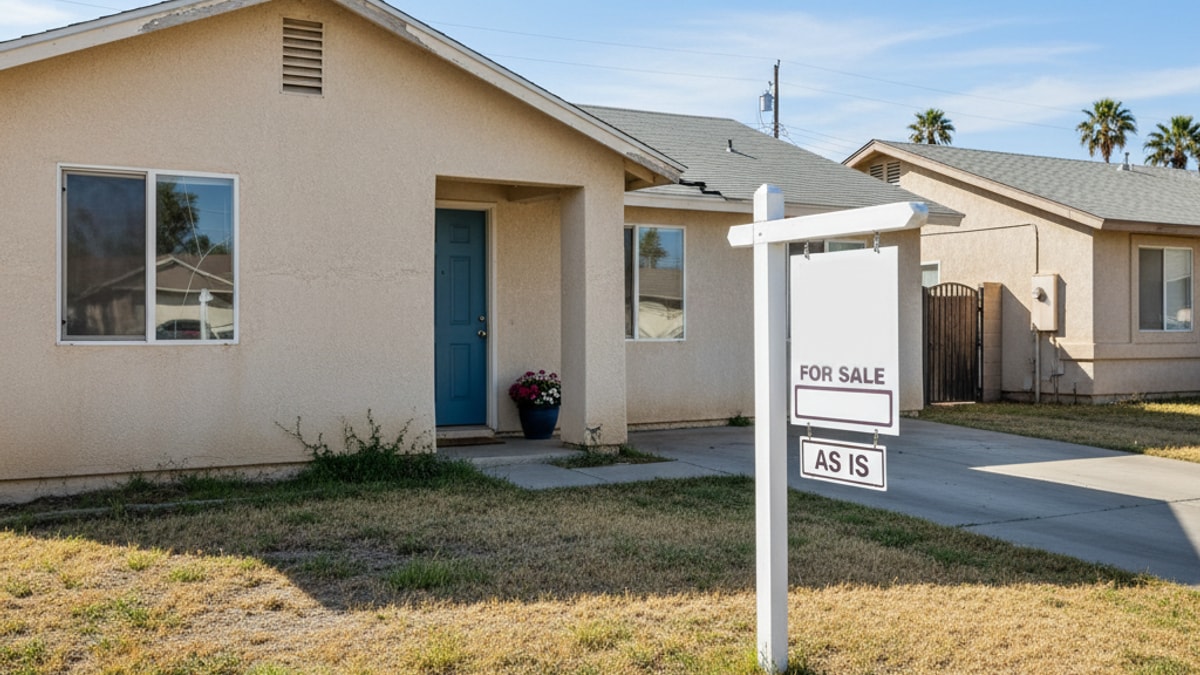
Most homeowners in Palmdale who sell as-is underestimate the buyer’s discount by 8–12%. Not because the house is worth less, but because they didn’t clarify which systems still function versus which are genuinely non-operational. A roof with five years of serviceable life left isn’t the same as a roof actively leaking during winter storms, yet both get lumped into the same ‘needs work’ category by buyers calculating repair budgets. The gap between market value and offer price often reflects unclear disclosure more than actual repair cost.
We’ve worked with hundreds of Palmdale sellers navigating as-is transactions. The difference between closing at a fair price and leaving money on the table comes down to three things most selling guides never mention: accurate system assessment documentation, California-specific disclosure compliance, and understanding which buyer types value speed over condition.
What does it mean to sell a house as-is in Palmdale?
Selling a house as-is in Palmdale means you’re offering the property in its current condition without making repairs, renovations, or improvements before closing. The buyer accepts the property with all existing defects. Visible or hidden. And waives the right to request repairs or credits based on inspection findings. However, California law still requires full disclosure of known material defects through the Transfer Disclosure Statement (TDS) and Natural Hazard Disclosure (NHD), and failing to disclose known issues can result in post-sale liability regardless of the as-is designation.
The common misconception is that ‘as-is’ means you can skip disclosures or hide problems. California Civil Code §1102 requires sellers to disclose all known material facts affecting property value or desirability. The as-is clause protects you from repair obligations, not from disclosure obligations. Buyers who discover undisclosed defects after closing can pursue legal action for rescission or damages even when the purchase agreement explicitly states ‘as-is, where-is’ language. This article covers the specific valuation adjustments Palmdale buyers apply to as-is properties, the disclosure requirements that remain non-negotiable under California law, and the three buyer categories most likely to close without repair requests.
How As-Is Sales Reduce Your Timeline and Carrying Costs
The as-is sale structure eliminates the repair negotiation phase that typically adds 14–21 days to escrow timelines in Palmdale’s conventional market. Standard transactions include a 17-day inspection contingency period during which buyers identify defects, request repairs or credits, and sellers either agree to terms or renegotiate. Each round of negotiation extends closing by 5–7 days on average. As-is sales with pre-inspection reports and firm offers close in 10–14 days because the buyer waives repair contingencies at contract signing.
Carrying costs accumulate daily: mortgage payments, property taxes, insurance, and utilities continue whether the house sits vacant or occupied. For a Palmdale property with a $2,400 monthly mortgage, $350 monthly tax bill, and $180 monthly insurance premium, each additional week on market costs $697 in fixed expenses. Not counting maintenance, HOA fees, or opportunity cost. Sellers facing job relocation, estate settlement deadlines, or pre-foreclosure timelines often recover more net proceeds through a fast as-is sale at 88–92% of after-repair value than waiting for a full-price conventional offer that takes 45+ days to close.
Cash buyers and investor buyers purchase as-is properties because they’re equipped to handle repairs directly through contractor networks at wholesale cost. These buyers factor renovation budgets into their offer price using precise per-square-foot repair estimates. Not inflated retail contractor quotes. A house needing $30,000 in repairs might receive an offer 12% below comparable sales, but if that offer closes in 12 days versus waiting 60 days for a financed buyer who requests $15,000 in seller credits, the net position favours the as-is route when carrying costs and sale certainty are calculated.
What California Disclosure Law Requires in As-Is Transactions
California Civil Code §1102 mandates that sellers of 1–4 unit residential properties complete a Transfer Disclosure Statement (TDS) disclosing all known material defects in structural components, mechanical systems, environmental hazards, and neighborhood nuisances. The TDS specifically asks about foundation cracks, roof leaks, plumbing failures, electrical defects, pest damage, soil settlement, and previous repairs. Vague answers like ‘unknown’ or ‘buyer to verify’ don’t satisfy the disclosure requirement when you have actual knowledge of problems.
Natural Hazard Disclosure (NHD) reports identify whether the property sits within special flood hazard zones, very high fire severity zones, seismic hazard zones, or wildland fire areas as mapped by FEMA and Cal Fire. Palmdale properties near the San Andreas Fault and in Antelope Valley’s wildland-urban interface often fall within multiple hazard zones. Disclosing this upfront prevents buyer rescission when the NHD report arrives 10 days into escrow. Third-party NHD companies charge $75–$150 to generate compliant reports that satisfy California statutory requirements.
Our team has seen sellers attempt to avoid disclosure by claiming ignorance of obvious defects. This strategy fails when the buyer’s inspector documents the issue and the timeline suggests the seller reasonably should have known. A foundation crack visible from the exterior, a water-stained ceiling, or a non-functional HVAC system discovered during a walkthrough all constitute ‘known’ defects under California case law. The legal standard isn’t whether you hired an engineer to diagnose the problem. It’s whether a reasonable person in your position would have been aware of the condition.
Sell House As Is Palmdale: Comparison
| Sale Method | Average Timeline | Typical Buyer Discount | Repair Obligation | Required Disclosures | Best For |
|---|---|---|---|---|---|
| As-Is Cash Offer | 10–14 days | 8–15% below market | None. Buyer accepts current condition | TDS and NHD still required | Sellers prioritizing speed, avoiding repair costs, or facing financial deadlines |
| As-Is Financed Buyer | 21–30 days | 5–12% below market | None, but buyer may request credits | TDS and NHD required; lender may require certain repairs | Sellers wanting faster close than conventional without full cash discount |
| Conventional Sale (Repairs Completed) | 30–45 days | 0–3% below market | Seller completes repairs before or during escrow | TDS and NHD required | Sellers with time and capital to maximize sale price through pre-listing improvements |
| Conventional Sale (Repair Credits) | 35–50 days | 3–7% below market (credit amount) | None, but seller provides cash credit at closing | TDS and NHD required | Sellers willing to negotiate but preferring cash credits over managing contractors |
Key Takeaways
- As-is sales in Palmdale eliminate the 14–21 day repair negotiation phase, reducing time to close by 40–60% compared to conventional transactions.
- California Civil Code §1102 requires full disclosure of known material defects even in as-is sales. The clause protects you from repair obligations, not disclosure obligations.
- Cash and investor buyers typically offer 8–15% below market value but close in 10–14 days, often netting sellers more after accounting for carrying costs and repair avoidance.
- The Transfer Disclosure Statement (TDS) and Natural Hazard Disclosure (NHD) are mandatory for all residential sales in California. Claiming ignorance of obvious defects exposes you to post-sale liability.
- Palmdale properties near the San Andreas Fault or in wildland-urban interface zones must disclose seismic and fire hazard zone classifications through compliant NHD reports.
- Pre-inspection reports ordered by the seller before listing reduce buyer uncertainty and support higher as-is offer prices by removing the ‘unknown defect’ risk premium.
What If: Sell House As Is Palmdale Scenarios
What If My House Has Foundation Cracks — Do I Have to Disclose Them?
Yes. California law requires disclosure of all known foundation defects regardless of sale type. Document the cracks with photos, note when you first observed them, and include this information on the TDS under Section I (Structural). If you’ve had an engineering evaluation, provide the report. Buyers will discover foundation issues during inspection; undisclosed cracks give them grounds to rescind the contract or sue for damages after closing.
What If the Buyer’s Lender Requires Certain Repairs Before Funding?
Conventional, FHA, and VA lenders enforce minimum property standards that can override as-is agreements. FHA loans require functional heating systems, intact roofing, and structurally sound foundations. If your property fails these standards, the lender won’t fund the loan even if the buyer agreed to purchase as-is. Cash buyers avoid this issue entirely. If you’re working with a financed buyer, confirm upfront which repairs the lender categorizes as mandatory versus optional.
What If I Receive Multiple As-Is Offers — How Do I Compare Them?
Compare net proceeds, not offer price. Calculate each offer’s true value by subtracting estimated closing costs, requested credits, and contingency risk. An all-cash offer at $415,000 with 10-day close and zero contingencies often nets more than a financed offer at $435,000 with 30-day close, appraisal contingency, and loan contingency. Verify proof of funds or pre-approval letters. Unqualified buyers cause deals to collapse in escrow.
The Unfiltered Truth About As-Is Sales
Here’s the honest answer: as-is doesn’t mean you get to hide problems or skip documentation. It means you’re offering the house in its current condition and refusing to make repairs. But California disclosure law doesn’t care about your sales strategy. The Transfer Disclosure Statement isn’t optional, plausible deniability doesn’t hold up in court when defects are obvious, and buyers who discover undisclosed issues after closing will come after you for damages regardless of what the purchase agreement says. Sellers who treat ‘as-is’ as a shortcut around disclosure requirements end up in litigation that costs more than fixing the original problem would have.
How to Price an As-Is Property Without Leaving Money on the Table
Pricing as-is properties requires subtracting estimated repair costs from comparable sales, then applying a 5–8% additional discount for buyer uncertainty. Start with recent closed sales of similar homes in move-in condition within a half-mile radius of your property. If comparable homes sold for $450,000 and your house needs $35,000 in documented repairs plus $15,000 in deferred maintenance, the baseline as-is value is $400,000. Apply an additional 5–8% discount ($20,000–$32,000) because buyers price in unknown defects they haven’t discovered yet. Landing at $368,000–$380,000.
Pre-inspection reports reduce the uncertainty discount. When you order a professional inspection before listing and provide the full report to prospective buyers, you’re eliminating the ‘what else is wrong’ risk premium that drives offers down. Buyers still discount for the cost of repairs, but they don’t add an extra buffer for hidden problems. A pre-inspection costs $400–$600 in Palmdale but typically recovers $8,000–$15,000 in final sale price by converting unknown defects into known, quantified issues.
We mean this sincerely: overpricing an as-is property guarantees it sits on market for 60+ days, accumulates stigma as a ‘stale listing’, and eventually sells for less than a correctly priced property would have netted in week one. Buyers researching as-is homes are sophisticated. They’re running repair estimates, comparing your price to recent sales, and moving on immediately if your number doesn’t pencil. Price at market minus repairs minus uncertainty premium, or accept that you’re waiting for the one buyer who doesn’t do math.
Selling your house as-is in Palmdale is a legitimate strategy when speed, simplicity, or repair avoidance outweighs maximizing sale price. But only if you disclose honestly, price realistically, and understand which buyer types value what you’re offering. If transparency and fast closing matter more than squeezing every dollar from the transaction, reach out through Home Helpers’ contact page before listing anywhere else.
Frequently Asked Questions
Can I sell my house as-is in Palmdale if it has code violations?
Yes, but you must disclose all known code violations on the Transfer Disclosure Statement under California Civil Code §1102. Buyers can still purchase properties with open violations — they assume responsibility for bringing the property into compliance after closing. However, some lenders refuse to fund loans on properties with active building department red tags or unpermitted additions, which limits your buyer pool to cash purchasers or portfolio lenders who accept higher risk.
How much less will I get for selling as-is versus making repairs first?
As-is sales in Palmdale typically net 8–15% below comparable move-in-ready properties, depending on repair scope and buyer type. A house needing $40,000 in repairs might sell for $380,000 as-is when comparable homes in good condition sell for $450,000 — the $70,000 difference reflects $40,000 in repair cost plus a $30,000 uncertainty discount. Pre-inspection reports reduce the uncertainty premium by documenting exact defects, often recovering $10,000–$20,000 in final sale price.
Do I still need a termite inspection for an as-is sale in California?
California doesn’t legally require termite inspections for residential sales, but lenders almost always require a Wood Destroying Pest Inspection Report (commonly called a termite report) before funding loans. If you’re selling to a cash buyer, you can skip the inspection entirely and let the buyer decide whether to order one. If you’re working with a financed buyer, expect the lender to require Section 1 termite repairs (active infestations) be completed before closing — you can negotiate who pays, but the work must be done for the loan to fund.
What happens if the buyer discovers undisclosed defects after closing?
California buyers who discover material defects you failed to disclose can sue for rescission (unwinding the sale), monetary damages (repair cost plus consequential damages), or both — even when the purchase agreement contains as-is language. Courts apply the ‘knew or should have known’ standard: if a reasonable seller would have been aware of the defect, claiming ignorance doesn’t protect you. Successful plaintiff cases often recover repair costs, attorney fees, and damages for diminished property value, sometimes exceeding $100,000 in total liability.
Can I sell as-is directly to an investor without listing on MLS?
Yes — off-market sales to investors are common for as-is properties in Palmdale. Direct sales eliminate listing agent commissions (typically 5–6% of sale price), avoid days-on-market stigma, and close faster since investors purchase with cash or portfolio financing not dependent on appraisals. However, off-market sales sacrifice buyer competition that drives prices up — you’re trading speed and convenience for potentially lower net proceeds. Compare at least three investor offers before accepting to ensure fair pricing.
How do property taxes work when selling as-is in Palmdale?
Property tax liability in California is prorated based on the closing date — you’re responsible for taxes through your ownership period, and the buyer assumes liability from closing forward. The escrow company calculates the proration at closing and adjusts settlement statements accordingly. If taxes are paid in arrears and you close mid-year, you’ll owe a prorated amount at closing. As-is designation doesn’t affect tax treatment — only the closing date determines each party’s proportional tax obligation.
Will selling as-is affect my capital gains tax calculation?
No — capital gains tax is calculated on the difference between your adjusted basis (purchase price plus capital improvements minus depreciation) and net sale proceeds, regardless of whether you sold as-is or after repairs. The IRS excludes up to $250,000 in gains for single filers or $500,000 for married couples filing jointly if you meet the ownership and use tests (owned and lived in the home for 2 of the last 5 years). As-is sales typically result in lower sale prices, which may reduce your taxable gain but don’t change the calculation method.
Can I back out of an as-is sale if I change my mind before closing?
Sellers can cancel a real estate contract before closing only under specific conditions outlined in the purchase agreement — typically during attorney review periods or if the buyer defaults on contingencies. If you simply change your mind without a valid cancellation clause, the buyer can sue for specific performance (forcing you to complete the sale) or monetary damages equal to their costs plus lost opportunity. California courts generally favor enforcing signed contracts, so consult a real estate attorney before attempting to withdraw from a binding agreement.
How does selling as-is compare to a short sale in Palmdale?
As-is sales occur when you owe less than the home’s current value and can close quickly without lender approval — you control the process and timeline. Short sales happen when you owe more than the property is worth and need lender permission to accept less than the mortgage balance — the lender controls approval, timelines extend 90–180 days, and the process often results in deficiency judgments or credit damage. If you have equity and want a fast exit, sell as-is; if you’re underwater and facing foreclosure, short sale or deed-in-lieu may be better options.
What repairs do FHA and VA buyers absolutely require for an as-is sale?
FHA loans require properties to meet Minimum Property Standards including functional heating, structurally sound roof with 2+ years remaining life, intact handrails on stairs, working plumbing and electrical systems, and no peeling paint in homes built before 1978. VA loans enforce similar standards plus require pest-free status in termite-prone areas. As-is sellers can’t avoid these repairs if working with FHA/VA buyers — either complete the mandatory repairs or target cash and conventional buyers who face fewer lender restrictions.
