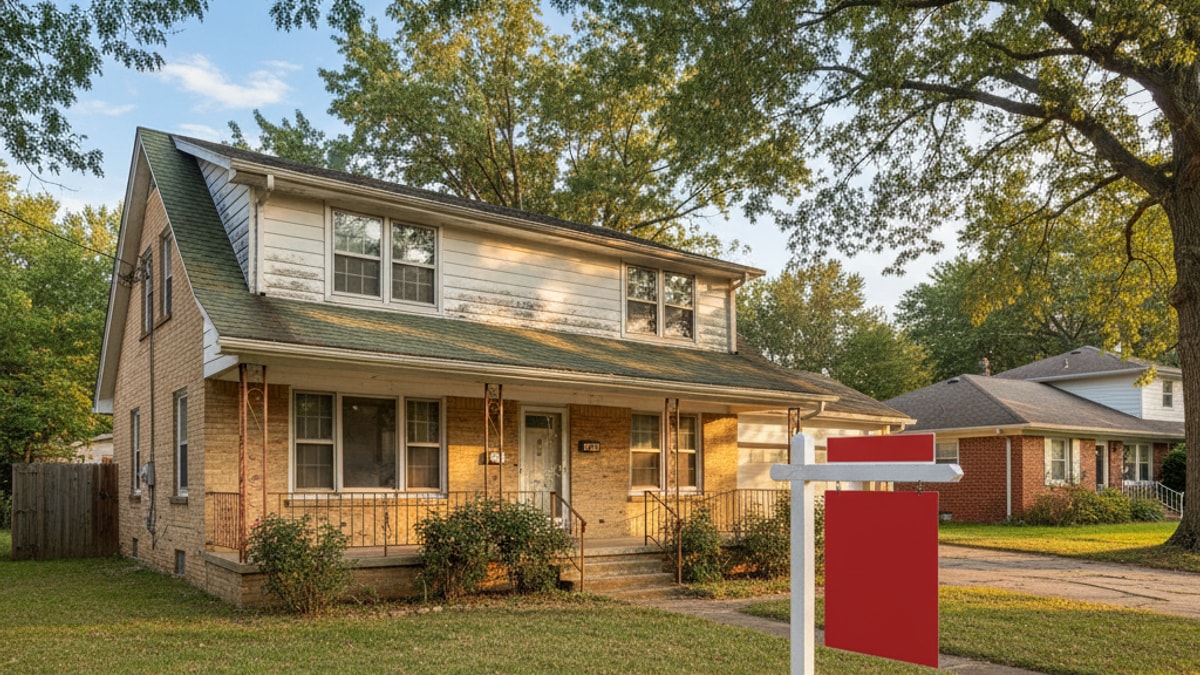
Most inherited properties sit vacant for 6–18 months while heirs debate what to do, and during that window, carrying costs compound. Property taxes, insurance, utilities, and HOA fees accumulate at roughly $800–$1,500 per month for a median-value home. Selling inherited house below market value isn’t a mistake if the math works: a 15% discount on a $300,000 property ($45,000) looks steep until you subtract 18 months of carrying costs ($18,000), realtor commissions you avoid by selling direct ($18,000), and the capital gains tax basis step-up that protects most of the discount. What looks like leaving money on the table is often recapturing costs that would’ve eaten the difference anyway.
Our team at Home Helpers has worked with hundreds of families navigating inherited property sales across every scenario. Multiple heirs with conflicting timelines, properties needing $40,000+ in deferred maintenance before they’re market-ready, and estates where liquidity matters more than maximising dollar recovery. The pattern we see consistently: families who move decisively within 90 days of inheriting typically come out ahead financially compared to those who hold for 12+ months chasing full market value.
What does selling an inherited house below market value actually mean in financial terms?
Selling inherited house below market means accepting an offer 10–30% below the property’s appraised fair market value in exchange for speed, certainty, or avoiding repair costs. The stepped-up tax basis you receive at inheritance. The property’s value on the date of death becomes your cost basis. Means most heirs pay zero or minimal capital gains tax even on below-market sales, making the true cost lower than the nominal discount suggests.
When Selling Below Market Makes Financial Sense
The decision to sell below market isn’t about desperation. It’s about comparing total net proceeds after all costs and risks. If an inherited property needs a new roof ($12,000), HVAC replacement ($8,000), and cosmetic updates to reach full market value ($15,000), you’re looking at $35,000 in upfront capital before listing. A cash buyer offering 15% below appraised value with no repair contingencies and a 14-day close eliminates that $35,000 spend, removes 3–6 months of market exposure risk, and stops the monthly carrying cost bleed.
Multiple heirs with different financial positions create timing pressure that traditional listings can’t accommodate. One heir may need their share immediately to cover medical expenses or debt; another may want to hold for appreciation. Selling inherited house below market to a direct buyer resolves the estate in one transaction, distributes proceeds within 30 days, and removes the ongoing friction of joint property management. Estate attorneys consistently tell us this is worth 10–15% in avoided family conflict and legal costs.
The stepped-up basis rule (IRC Section 1014) resets your cost basis to the property’s fair market value on the date of the decedent’s death. If the property was worth $280,000 when inherited and you sell for $250,000 six months later, your taxable gain is zero. You’re below basis. Even aggressive below-market discounts rarely trigger capital gains for heirs who sell within the first year, which fundamentally changes the economics compared to selling your own primary residence.
The Hidden Costs of Holding for Full Market Value
Carrying an inherited property to achieve full market pricing costs $800–$1,500 monthly in hard expenses: property taxes don’t pause during probate, homeowners insurance remains mandatory even on vacant properties, utilities must stay on for showings, and HOA fees continue accruing regardless of occupancy. A 180-day listing period to capture an extra $20,000 in sale price costs $7,200–$13,500 in carrying expenses before you factor in realtor commissions (typically 5–6% of sale price).
Deferred maintenance compounds faster on vacant properties than occupied ones. HVAC systems that aren’t run monthly seize up. Plumbing seals dry out and crack. Landscaping overgrows. We’ve seen properties lose $15,000–$25,000 in condition-driven value during a 12-month listing period because no one was monitoring systems or addressing small issues before they became structural problems. Insurance claims on vacant properties face higher scrutiny and lower coverage limits. Your policy may exclude certain perils entirely after 60 days of vacancy.
Realtor commissions on a $300,000 sale run $15,000–$18,000, and that’s before factoring in seller concessions, closing costs, and title fees that add another 2–3% to the total transaction cost. A direct buyer offering $255,000 with zero commissions and a $3,000 total close cost nets you $252,000. A traditional listing at $300,000 with 6% commission and 3% in other costs nets you $273,000. The difference is $21,000, but it cost you 6 months and significant stress to capture it.
Selling Inherited House Below Market: Property Condition vs. Sale Strategy Comparison
| Property Condition | Traditional Listing Timeline | Expected Net (After Costs) | Direct Sale Discount | Net After Direct Sale | Time to Close | Our Assessment |
|—|—|—|—|—|—|
| Move-in ready, no repairs | 60–90 days | $285,000 (on $300k sale, 5% commission) | 8–12% below market | $264,000–$276,000 | 14–21 days | Traditional listing justified unless speed is critical |
| Needs $10k–$25k in repairs | 90–150 days (includes repair time) | $270,000 (on $300k sale post-repair) | 15–18% below market | $246,000–$255,000 | 14–21 days | Direct sale makes sense if you lack capital for repairs upfront |
| Needs $30k+ in structural work | 120–180+ days | $255,000 (on $300k sale post-repair) | 20–25% below market | $225,000–$240,000 | 7–14 days | Direct sale almost always better. Repair ROI rarely justifies the time and risk |
| Property in probate or estate dispute | 180+ days (legal resolution required) | Highly variable, $240k–$280k | 15–22% below market | $234,000–$255,000 | 30–45 days (after court approval) | Direct sale preferred. Carrying costs and legal fees compound during delay |
| Multiple heirs, conflicting timelines | 120–240 days (consensus-dependent) | $260,000–$280,000 (assuming agreement) | 12–18% below market | $246,000–$264,000 | 21–30 days | Direct sale solves coordination problem that traditional sale cannot |
Key Takeaways
- The stepped-up tax basis (IRC Section 1014) resets your cost basis to the property’s value at inheritance, meaning most heirs pay zero capital gains tax even on below-market sales within the first year.
- Carrying costs of $800–$1,500 monthly (taxes, insurance, utilities, HOA fees) accumulate during listing periods and directly reduce the net benefit of waiting for full market value.
- Realtor commissions (5–6%) plus closing costs (2–3%) consume 7–9% of sale proceeds on traditional listings, narrowing the actual gap between market-rate and discounted direct sales.
- Properties requiring $25,000+ in repairs rarely justify the repair investment when selling. Direct buyers absorb that cost in their discount, removing upfront capital requirements.
- Multiple heirs with different liquidity needs create timing pressures that traditional listings cannot accommodate. Selling inherited house below market resolves estates in one transaction.
- Vacant inherited properties lose condition-driven value faster than occupied homes due to deferred system maintenance and environmental exposure during extended listing periods.
What If: Selling Inherited House Below Market Scenarios
What if the property needs major repairs but you don’t have cash for upfront work?
Sell directly to a cash buyer at 18–22% below post-repair market value. The buyer assumes all repair costs and risk, you avoid financing renovation work or depleting estate assets, and the transaction closes in 14–21 days with zero contingencies. Financing repairs through a home equity line requires estate executor authority and personal guarantees most heirs don’t want to provide.
What if multiple heirs disagree on whether to sell or rent the property?
Propose a direct sale with a 60-day feasibility window: one heir buys out the others at a mutually agreed valuation (typically 10–15% below market to compensate for liquidity), or the property sells to a third-party buyer. Holding rental property as co-owners across state lines creates liability, management complexity, and tax reporting requirements that consistently lead to disputes. Resolve ownership before attempting to operate as landlords.
What if the property is in probate and the estate needs liquidity immediately?
File a petition for early distribution or court approval of sale. Most probate courts allow estate sales at reasonable market value even before final distribution if the estate needs liquidity to pay debts, taxes, or maintain other assets. Direct buyers experienced in probate transactions close in 30–45 days after court approval, compared to 90–180 days for traditional listings that require multiple court appearances and appraisal contingencies.
The Blunt Truth About Selling Inherited House Below Market
Here’s the honest answer: selling an inherited house 15–20% below market isn’t leaving money on the table if the alternative is carrying the property for 12+ months at $1,200/month while chasing an extra $30,000 in sale price that realtor commissions and closing costs will consume anyway. The families who regret below-market sales are those who accepted 30%+ discounts without understanding their stepped-up basis or exploring multiple buyer options. Not those who made an informed decision to prioritise speed and certainty over marginal price optimisation. Our team has closed transactions where the below-market direct sale netted the heirs $8,000–$15,000 more than a traditional listing would have after factoring in all costs and realistic timelines.
Understanding Your Stepped-Up Tax Basis and Sale Timing
The stepped-up basis rule fundamentally changes inherited property economics compared to selling your own home. When you inherit real estate, the IRS resets your cost basis to the property’s fair market value on the date of death (or six months later if the executor chooses the alternate valuation date under IRC Section 2032). If your mother bought a house in 1985 for $80,000 and it’s worth $300,000 when she passes in 2025, your basis is $300,000. Not $80,000. Selling for $285,000 six months later generates a $15,000 capital loss, not a $205,000 gain.
This basis step-up protects most below-market sales from capital gains tax entirely. Selling inherited house below market at 12–18% discount typically keeps you within or below your stepped-up basis, especially if the property declines in condition during the months between inheritance and sale. The IRS allows basis adjustments for estate expenses (executor fees, attorney costs, property maintenance during probate) that further reduce taxable gain. Only properties held for multiple years after inheritance or sold significantly above the date-of-death valuation generate meaningful capital gains for heirs.
Timing matters for a different reason: the longer you hold an inherited property, the more you convert a zero-tax inheritance into a taxable investment. Every month of appreciation after the inheritance date becomes taxable gain. Every month of rental income becomes taxable ordinary income. Families who inherit a property, hold it for five years while renting it out, then sell for full market value pay capital gains on 100% of the appreciation since inheritance. Which can exceed the tax savings from waiting. We’ve found that heirs who sell within 12 months of inheritance capture the full tax benefit of the stepped-up basis while minimising carrying costs and market risk.
You’ve just inherited a property you never expected to manage, and the pressure to make the right decision feels immediate. The gap between the price a cash buyer offers and what Zillow shows isn’t a measure of fairness. It’s the difference between immediate certainty and deferred hope. Most families who choose speed and closure at a 15% discount look back six months later and realise they came out ahead financially compared to the alternative they avoided: months of carrying costs, repair surprises, and the compounding stress of managing an asset they never wanted in the first place.
Frequently Asked Questions
How does selling inherited house below market work?
selling inherited house below market works by combining proven methods tailored to your needs. Contact us to learn how we can help you achieve the best results.
What are the benefits of selling inherited house below market?
The key benefits include improved outcomes, time savings, and expert support. We can walk you through how selling inherited house below market applies to your situation.
Who should consider selling inherited house below market?
selling inherited house below market is ideal for anyone looking to improve their results in this area. Our team can help determine if it’s the right fit for you.
How much does selling inherited house below market cost?
Pricing for selling inherited house below market varies based on your specific requirements. Get in touch for a personalized quote.
What results can I expect from selling inherited house below market?
Results from selling inherited house below market depend on your goals and circumstances, but most clients see measurable improvements. We’re happy to share case examples.
